What Are the Best Features to Look for in Period Swimwear?
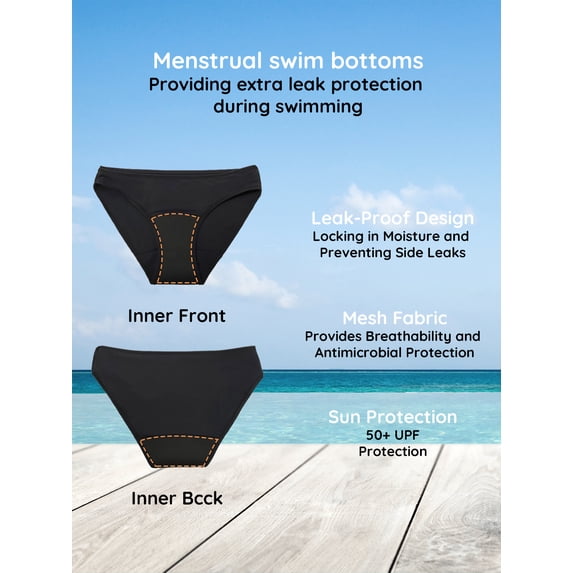
The best period swimwear should combine a close-fitting absorbent gusset, water-resistant outer fabric, reliable leak protection, fast drying, strong stretch recovery, and comfortable seams. ACOG notes that average menstrual blood loss is around 30 mL per cycle, while losses above 80 mL have historically been associated with heavy bleeding, so one swimsuit cannot suit every flow level. Pool conditions matter too: CDC guidance places typical chlorine levels around 1–4 ppm with pH at 7.0–7.8. Fit and gusset construction matter as much as stated absorbency, because gaps around the legs can allow fluid to escape before the absorbent layers can manage it.
A good pair of period swimwear is built differently from ordinary period underwear. Regular absorbent underwear is designed to take in liquid from the body, while swimwear must accept menstrual fluid without becoming saturated with pool water. Most useful designs therefore separate the job across several thin layers rather than relying on one thick pad. A typical construction uses a soft inner layer, an absorbent textile, a leak-resistant membrane, and the outer swimsuit fabric.
The amount of protection should match actual menstrual flow rather than marketing terms alone. ACOG has reported mean blood loss of about 30 mL across an entire menstrual period, while more than 80 mL per cycle has traditionally been associated with heavy menstrual loss. A person changing menstrual products every 1–2 hours, especially for more than 7 days, may be experiencing heavier bleeding than period swimwear is designed to manage on its own.
Absorbency numbers are useful only when the brand explains how they were measured. “Equivalent to two tampons” is less informative when tampon size, laboratory method, liquid type, and test conditions are not stated.
The gusset should therefore be judged by both capacity and dimensions. Wider front-to-back coverage gives menstrual fluid more material to reach during walking, sitting, swimming, or getting out of the water. A narrow absorbent strip may hold several milliliters in a controlled test but still perform poorly if movement places fluid beyond the absorbent area.
Fit becomes the next consideration because the gusset can only collect fluid when it remains close to the body. The waistband should stay level, the crotch should not hang away from the skin, and the leg openings should return to position after kicking or bending. A swimsuit that is one size too loose can create several millimeters of space around the groin, which may matter more during movement than an extra layer of absorbent material.
Look closely at the leg opening rather than assuming tighter is always safer. Excess compression can cause rubbing, leave marks, and make a swimsuit uncomfortable for 2–4 hours of pool or beach use. A better fit uses elastic recovery to maintain contact without strong pressure. Size charts based on waist and hip measurements are more useful than relying only on labels such as S, M, or L.
| Feature | What to inspect | What poor construction looks like |
|---|---|---|
| Gusset | Full front-to-back coverage | Short or narrow absorbent area |
| Leg opening | Firm contact after movement | Gaping or rolling |
| Waist | Stable without digging in | Sliding or strong compression |
| Inner layer | Smooth, flat surface | Wrinkles or bulky edges |
| Outer fabric | Fast-draining swim textile | Heavy water retention |
Fabric composition also deserves attention because swimwear is exposed to conditions that ordinary underwear rarely encounters. CDC guidance for swimming pools recommends at least 1 ppm free chlorine, while typical pool chlorine may fall around 1–4 ppm. Chlorinated water repeatedly contacts elastane, seams, printed surfaces, and laminated membranes, so repeated pool use can gradually change stretch and surface feel.
ISO addressed this issue with ISO 17608:2015, a standard for measuring the resistance of bare elastane yarn to chlorinated swimming-pool water. The method considers three chlorine concentrations and two exposure periods, although ISO explicitly notes that yarn results cannot predict the performance of a finished fabric. The standard was reviewed and confirmed again in 2026, showing why chlorine resistance remains a measurable textile property rather than a vague product claim.
Polyester and nylon blends are both common in swimwear, usually combined with elastane for stretch. Polyester is widely used in training swimwear because many constructions tolerate repeated chlorinated-water exposure well, while nylon often provides a smooth hand feel and strong stretch. The percentage alone cannot prove durability: a swimsuit labeled 80% nylon and 20% elastane can perform very differently from another garment with the same fiber percentages because yarn type, knitting density, finishing, lining, and seam construction also differ.
Water management is equally important. The outer surface should release water quickly rather than behave like a towel, while the internal absorbent zone should retain menstrual fluid long enough to reduce leakage. A very thick absorbent insert can take longer to dry and may feel noticeably heavier after 30–60 minutes in the water.
More absorbent material is not automatically better for swimming. Added thickness may increase water retention, drying time, visible bulk, and movement inside the swimsuit.
A useful product description should explain the intended flow level and preferably give a measurable capacity. If a brand states 10 mL, 15 mL, or another figure, check whether the number refers to total laboratory saturation or a practical wear recommendation. Total saturation measured on a dry sample may not reproduce use in a swimming pool, where water pressure, movement, stretching, and repeated immersion change how the layers behave.
Leak-resistant membranes also need flexibility. A membrane that blocks liquid but feels stiff can fold at the crotch, producing gaps along the edges. During a 30-minute swim, thousands of leg movements can repeatedly stretch this area, so the membrane, absorbent layer, stitching, and outer fabric need to move together rather than separating into rigid sections.
Seam placement can reveal a great deal about construction quality. Thick seams at the inner thigh may rub once the fabric becomes wet, while exposed edges around the gusset can become more noticeable during long beach or pool sessions. Flat, smooth joins generally make more sense in areas exposed to repeated movement.
The protective area should also stay visually discreet. A functional gusset does not need to resemble a sanitary pad sewn inside a bikini bottom. Well-integrated layers lie flat and follow the shape of the garment. This matters more in fitted bikini styles, where an extra 3–5 mm of thickness can become easier to see through wet outer fabric.
Opacity should be checked separately from absorbency. Light-colored swim fabrics can become more transparent after saturation, especially when stretched across the hips or seat. A proper lining adds another layer between the skin and outer shell and can reduce show-through without requiring a very heavy fabric.
For active swimming, stability deserves more attention than decorative details. Lap swimmers, surfers, and people playing water sports create much greater fabric movement than someone sitting beside a pool. A secure waistband, moderately firm leg openings, supportive straps, or a drawstring can reduce shifting over a 45–60 minute session.
One-piece and bikini designs can both work well, but the load is distributed differently. A one-piece uses the torso to help stabilize the lower section, while bikini bottoms rely mostly on waistband tension, hip shape, and leg elastic. Buyers with measurements between two sizes should follow the maker's measurement chart rather than automatically sizing down to obtain more pressure.
Care instructions affect long-term performance as well. CDC pool guidance places recommended pool pH around 7.0–7.8, and disinfectants, salt, sunscreen, sweat, and body oils can remain in the fibers after use. Rinsing with fresh cool water after swimming removes a large portion of these residues before they remain on the fabric for hours.
High heat is usually unnecessary for stretch swim textiles. Elastane and laminated leak-resistant materials can respond poorly to repeated hot drying, while fabric softener may leave coatings on moisture-handling fibers. Manufacturer washing directions should take priority because construction varies, but air drying is common for reusable menstrual swim products.
Durability claims should be examined with the same care as absorbency claims. “Chlorine resistant” is more useful when a brand identifies a test method, number of wash cycles, exposure time, or fabric specification. ISO 17608:2015 itself uses defined chlorine exposures and breaking-force retention rather than judging a yarn by appearance alone.
A product page should therefore provide enough information to answer practical questions before purchase:
-
What flow level is the garment intended for?
-
Is absorbency stated in mL or only as a product-equivalent claim?
-
How far does the gusset extend toward the front and back?
-
What percentages of polyester, nylon, and elastane are used?
-
Is the swimsuit fully lined or only lined at the crotch?
-
Are chlorine resistance or wash-life claims supported by a test method?
-
Does the size chart provide waist and hip measurements?
-
Does the maker recommend backup protection for heavier-flow days?
Price should be considered after construction rather than before it. Two products priced at $35 and $70 may use similar fiber percentages while differing in gusset length, lining, seam finishing, elastic recovery, and testing information. A higher price does not demonstrate better leak protection unless the added cost corresponds to measurable design or material differences.
Safety claims also need careful wording. In the United States, the FDA classifies unscented menstrual tampons as Class II medical devices under regulation 21 CFR 884.5470, while reusable menstrual pads fall under a different regulatory classification. A swimsuit marketed for menstrual management should not automatically be assumed to have undergone the same FDA review pathway as a tampon simply because both deal with menstrual fluid.
Flow level remains the final practical filter. ACOG notes that changing menstrual products every 1–2 hours may indicate excessive bleeding, particularly when bleeding continues beyond 7 days. Someone with that pattern should not rely on a swimsuit's marketing capacity alone; period swimwear may be more appropriate as backup protection or for lighter-flow portions of the cycle.
For lighter or moderate use, look for a close gusset, stable leg openings, measurable absorbency information, low-bulk layers, good lining coverage, and fabric made for repeated water exposure. A product that explains its materials, fit measurements, care limits, and testing conditions gives the buyer more usable information than a broad “leakproof” claim with no numbers behind it.